Sustainability strategy
Sustainable well-being, affordable housing, a society that improves the well-being of nature and humans, developing partnerships and co-operation networks, and making sustainability work visible – these are some of the goals of our sustainability work at Hoas. Our sustainability goals are defined on our sustainability strategy which guides our sustainability work until 2030.
We provide student housing whose environmental and sustainability impacts are managed systematically and measured transparently. We have calculated our carbon footprint in accordance with the GHG Protocol, developed a carbon roadmap to reduce emissions, and focus our efforts on the areas where we can make the greatest impact, including construction, renovation, energy, and procurement. In our new developments, we apply low-carbon construction principles, improve the energy efficiency of our properties through a structured approach, and work with key service providers to reduce emissions across our value chain. We have also conducted a double materiality assessment to identify the sustainability topics most relevant to our operations and stakeholders.
Sustainability strategy
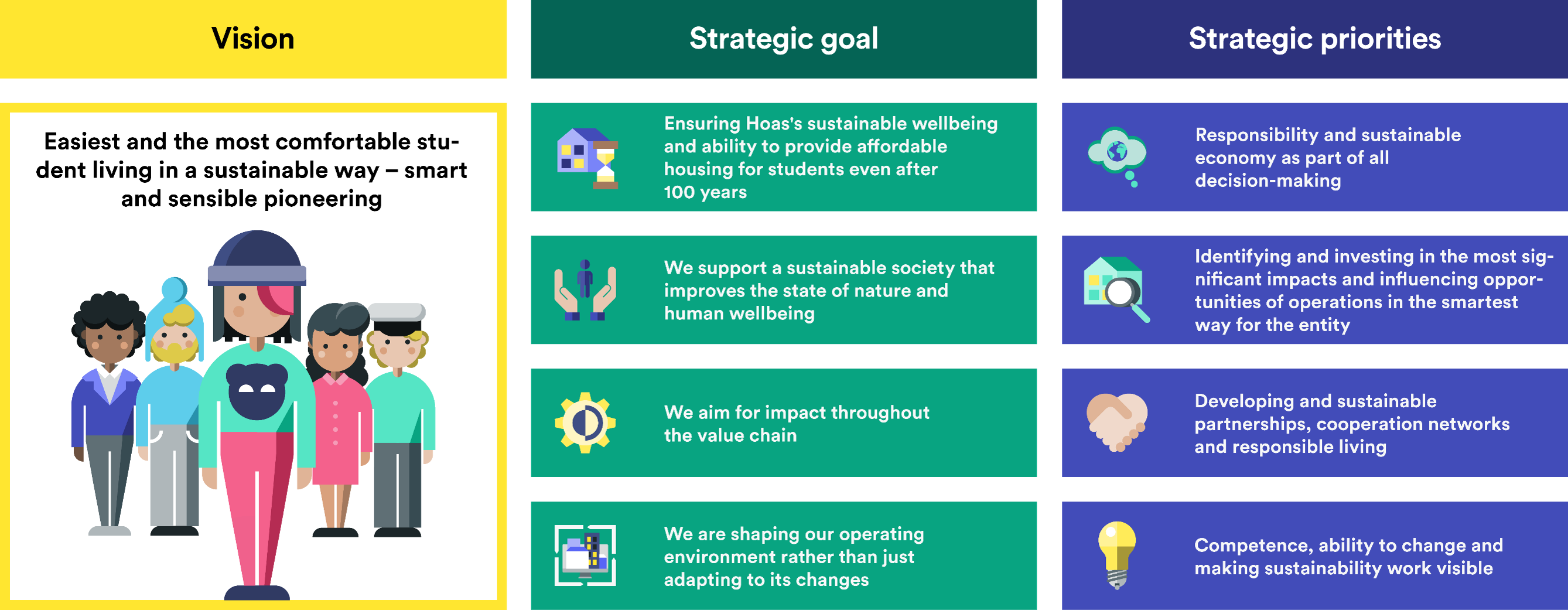
Strategic goals and priorities divide our sustainability strategy into sections that together aim towards the easiest and most comfortable student living in a sustainable way with smart and sensible pioneering.
Sustainable well-being
We want Hoas to thrive as a foundation, and we want that the houses being built today will be used by students even a hundred years from now.
This requires maintenance of sustainable finances, proactive reactions to changing laws and regulations, understanding of the evolving expectations of our tenants, correct investments in good locations and ensuring the high quality and cost-effective longevity of the buildings.
What do we do?
- We evaluate overall systems and impact to identify the most effective ways to steer our operations toward greater sustainability.
- We develop industry practices through broad collaboration — both with our partners and by influencing networks such as RAKLI and FIGBC.
- We lead with data, and to expand our knowledge base, we collaborate with universities and other academic institutions.
- We are continuously developing our sustainability reporting.
- We ensure data protection and are actively improving our practices related to privacy and data security.
Best opportunities to achieve change
Our building stock is the largest source of greenhouse gas emissions in our operations. Our new houses are built in accordance with our low-carbon construction guidelines, and their climate effects are taken into account throughout their entire life cycle, from planning to construction, use, maintenance and demolition. The existing building stock is maintained and repaired in a timely manner, which increases the buildings’ life cycle. Energy-efficiency is improved in a controlled manner in accordance with our own energy management plan, and energy is acquired from renewable sources.
In all our sustainability work, we focus on issues in which we are proven to have the best opportunities to achieve change. To learn about the actual impact of our actions, we will develop data collection and methods for proving the effectiveness of different measures.
What do we do?
- We calculate the carbon footprint of our new developments and are extending this practice to major renovation projects as well. Based on these calculations, we identify the key factors that contribute most to a building’s carbon footprint, enabling us to reduce emissions effectively during construction.
- We use a low-carbon construction guideline to systematically reduce the carbon footprint of our development projects.
- We assess the climate impact of new projects across their entire life cycle.
- We maintain and repair our existing building stock proactively and at the right time.
Corporate social responsibility and partnerships
Supporting young people with managing sustainable daily life is part of our corporate social responsibility. A home at Hoas is a many young person’s first own home, where they practice independent living. We invest in comprehensive tenant services and strive to be able to help and support our tenants in any questions related to housing. By supporting daily living and making it easier, we also aim to support the development of sustainable habits. This is a way of growing the impact of our handprint.
To achieve our sustainability goals, we need partners that are committed to our sustainability goals and develop their own operations to support them. Additionally, they provide us with concrete and effective tools that support our sustainability strategy, which we can use to develop our operations. In best case scenarios, we can develop ourselves and our operations together with our partners.
What do we do?
- We build all our new developments in well-connected locations, close to public transport and essential services.
- We use high-quality, durable materials in our properties.
- We provide as many waste bins in our new residential buildings as there are recyclable waste types in the area.
- We have integrated sustainability into our service agreements and procurement processes.
- We incorporate ethical principles into all of our contracts.
- We apply the Aware worksite concept to ensure the social responsibility of our construction projects.
- Together with our partners, we are advancing the transition to material-based accounting for Scope 3 emissions.
Creating a solution-oriented culture
Transformation of the green transition, digitalisation and service development in our industry is just beginning. By making our sustainability work concrete and visible, we contribute to systemic change that creates prerequisites for future wellbeing and sustainable development.
We develop our operations intelligently and sensibly, however, constantly sensing the weak signals of the future. Co-learning in cooperation networks takes the development of sustainable business and the green transition forward most effectively.
Building a fair and sustainable future requires supporting the personnel’s competence and ability to change, as well as the creation of a solution-oriented culture that inspires cooperation.
What do we do?
- Our Head of Sustainability is a member of the management team.
- Our sustainability strategy includes targets for every department.
- The achievement of sustainability goals is linked to the management team’s incentive scheme.
- We conduct an annual sustainability survey for our staff.
- Sustainability is a recurring theme in our internal staff briefings.